My research lies at the intersection of invasion ecology and restoration ecology, with the overarching goal of contributing science-based solutions to the global environmental crisis. I focus on understanding why invasive plants succeed, how they transform ecosystems, and why their impacts often persist long after removal.
Invasion Legacies and Ecosystem Transformation
I study legacy effects—the long-lasting changes invasive species leave behind in soils, microbial communities, and ecosystem processes—which can strongly shape restoration outcomes long after invaders are gone. My current work aims to develop and test a mechanistic framework to classify these legacy effects, distinguishing between resource-driven and biota-driven pathways, using literature synthesis, expert input, and field experiments in Argentina.
A central component of my research examines plant–soil feedbacks, particularly those generated by invasive nitrogen-fixing legumes. Through field studies in South African fynbos with Australian Acacia species and collaborative experiments in Europe, I investigate how invasive plants alter soil chemistry, microbial communities, and plant performance, and how these changes persist after removal. These insights have direct relevance for large-scale invasive plant management and post-clearing restoration.
Designing Invasion-Resistant Communities
I also explore whether invasion-resistant plant communities can be intentionally designed using ecological theory and the role that biotic resistance have in preventing plant invasions. By testing how functional trait similarity and phylogenetic relatedness between native and invasive species influence competition, I evaluate predictions from coexistence theory and invasion hypotheses.
Synthesis and moving ecology (and ecologists) forward
Alongside this empirical work, I contribute to international synthesis efforts that integrate and map invasion theories, helping to identify general patterns and inform more effective restoration and management strategies. Beyond ecological mechanisms, I am also deeply interested in rethinking how ecological knowledge is produced and used, emphasizing ethical responsibility, collaboration with local and Indigenous communities, and the role of scientists as agents of societal change.
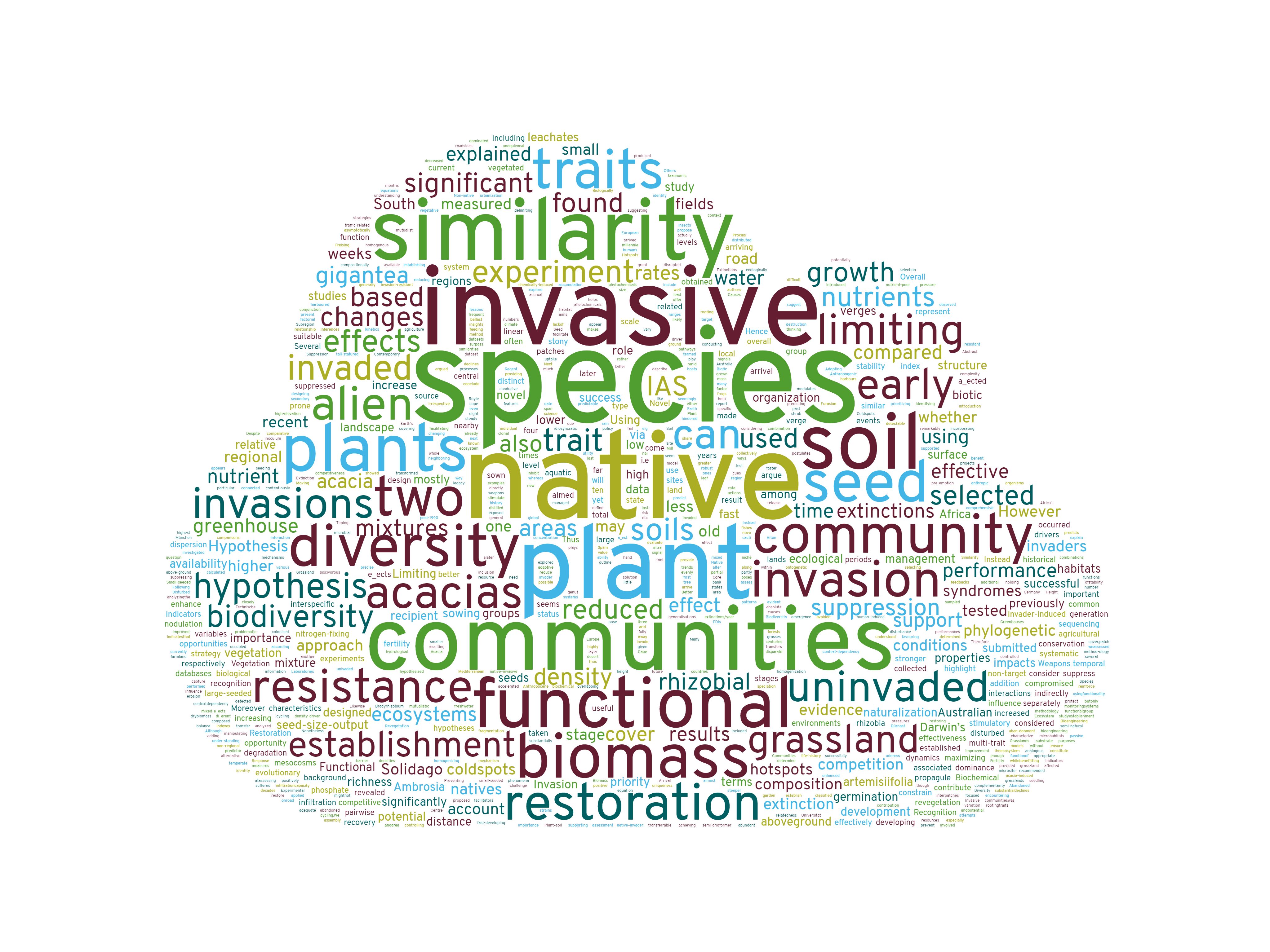
Wordcloud showing terms used in titles and abstracts from my publications up to April 2021.


 Dr. Florencia Yannelli